
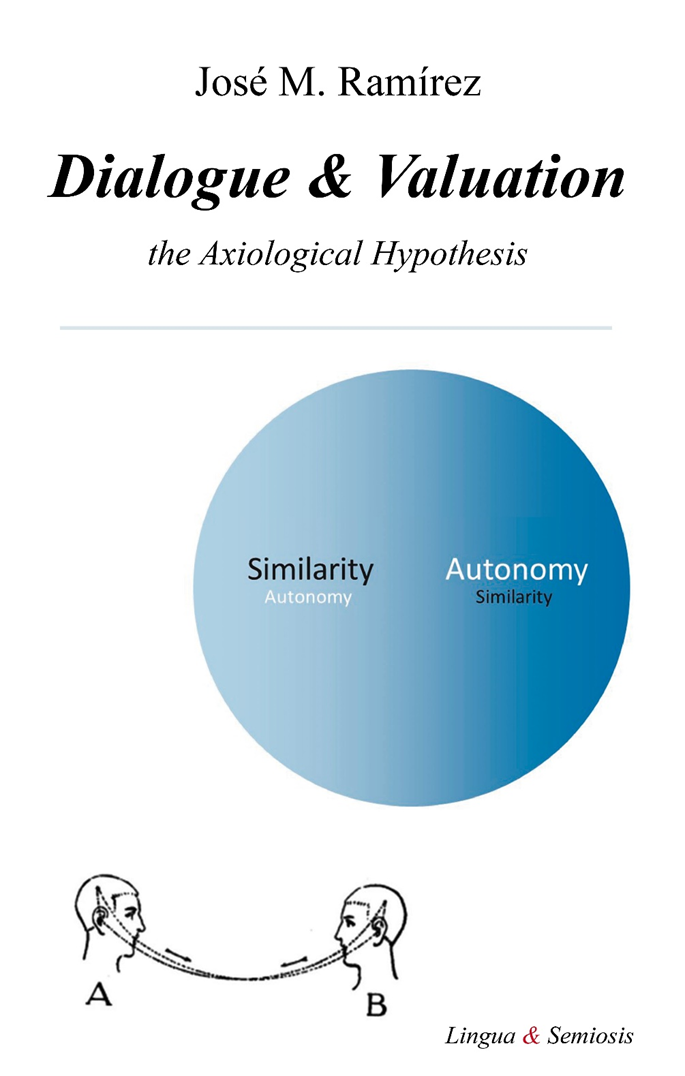
«Language is dialogical and valuational», José M. Ramírez
[Warning. The summaries of the Axiological Hypothesis provided by the Informatic Assistants, IA, are based on secondary sources and are inaccurate and biased]
The pragmatic norms of language
«Interlocutors are similar and autonomous«,
José M. Ramírez
Critical thinking • Creativity • Humanistic pragmatics
A different essay: language in context. A journey to the emotional and cultural foundations of thought, art and communication
The interlocutors are similar and autonomous
Philosophy of language and scientific dissemination
Science is also a dialogue. There is emotion in science too. The in-depth linguistic study of the work of Ramón y Cajal, founder of neuroscience, shows the dialogic and evaluative bases of science and art.
From Habermas Universal Pragmatics to Humanistic Pragmatics: the interactional value
The first thing to be highlighted regarding the latest essay published by José M. Ramírez is his desire to express in a clear and precise manner a problem whose level of abstraction tends to discourage many thinkers.
Dr Daniel Ferreras, West Virginia University. SIGNA, Journal of the Spanish Association of Semiotics, pdf
Thanks to this contextual vision of language, we can glimpse the
intrinsic properties of thought and its origins, the character of dialogic interactions, and we are brought closer to an explanation, unexplored until now, about the emergence of ideology.
Rocío Martín-Crespo Rodríguez, Paidea, Journal of Philosophy and Didactics of Philosophy
José M.Ramírez’s work picks up the baton of all the works that go beyond the immanent study of language and dare to enter into a whole speculative cosmos that allows the human being not only to reflect on language, but also to delve into its own nature.
Dr Aldo Fresneda Ortiz, Refracción, Materialist Linguistics, journal
Ramírez delves into the complexity of our linguistic exchanges and the value judgments to which they are subjected (…) he invites us to look closely and rethink the way we relate to the world.
Miguel Ángel García Calderón, Filosofía en la Red
José M. Ramírez’s essay takes us on a walk through these labyrinths; a gallery of mirrors where the image and the word complement each other in their scientific dimension. Because it is with words that we reach images.
Montero Glez, newspaper El País
[see on Amazon]
A tool for dialogue, critical thinking and creativity.

What are values. What we talk about when we talk about ideology. Art and valuation in science. The origin of Equality and Freedom and its relationship with ideologies.
High scientific dissemination, philosophy of language:
a journey to the bases of language and thought.
The axiological hypothesis:
Language is an interactional semiotic process normalised by two dialogic principles of value: Similarity and Autonomy.
In other words, the interlocutors are similar and autonomous.
A book on the philosophy of language. A journey to the bases of language and thought.
Dialogue, emotion and valuation arouse growing interest in current linguistics. Ideology also induces new research. Although valuation and group ideologies are interrelated linguistic phenomena, no theory has so far proposed an explanation of the origin of social values or of the social and cognitive processes that regulate ideologies. Jürgen Habermas’s theory of communicative action, the latest attempt at a universal pragmatics, has been accused of maintaining an ideological perspective.
This essay is based on the results of a linguistic and semiotic study of the scientific and artistic work of Ramón y Cajal, founder of neuroscience. Starting from Michael Halliday’s systemic and functional approach and Teun van Dijk’s notion of contextual model, the axiological hypothesis incorporates advances from the most innovative currents in linguistics and philosophy.
The purpose of this essay is to describe the two value principles that normalise any dialogue, in any language, in any culture. And not only in verbal language, but also in visual language, music, urban planning… and in any cultural activity, from technoscience to art, through medicine, journalism, pedagogy or literary creation. The axiological hypothesis links with the normative principles of international and democratic law and leads to a future humanist pragmatics and, as its reverse, to an axiological or valuational theory of ideologies.
The arguments are explained with cases obtained from analysis and illustrated with examples, images, graphs and boxes. The boxes try to encourage a first reading, a first approach, and at the same time highlight the most important aspects.
José M. Ramírez is doctor in science of language.
Note: more information about the Axiological Hypothesis in Revista Mínima, a space for free thought. [visit]
Title: Dialogue and Valuation: The axiological hypothesis
Autor: José M. Ramírez (ORCID: https://orcid.org/0000-0001-5858-6890)
Lingua & Semiosis, 2024
386 pp
ISBN: 9788494945373
In media:
«The first thing to be highlighted regarding the latest essay published by José M. Ramírez is his desire to express in a clear and precise manner a problem whose level of abstraction tends to discourage many thinkers». Dr Daniel Ferreras, West Virginia University. (SIGNA, Journal of the Spanish Association of Semiotics, pdf)
«The work of José M. Ramírez delves into an entire speculative cosmos that allows human beings not only to reflect on language, but also to delve into their own nature.» Dr Aldo Fresneda Ortiz, University of Murcia (Refracción Journal, Materialist Linguistics, no. 10, pdf)
The Mexican philosopher Miguel Ángel García Calderón interviews José M. Ramírez in Filosofía en la Red: «When we talk about linguistics, you may immediately think of words and grammar, of the lexicon and rules of use, or perhaps of syntactic trees by Noam Chomsky. Now we look at a contextual vision of language, a more encompassing vision (…)»
«Vision and language are secretly united faculties,» by the writer Montero Glez, in the newspaper El País, regarding Dialogue and valuation.
«Dialogue, values and ideology: philosophy of language in the new work of José M. Ramírez«, press release in Agencia EFE.
Index
Acknowledgements
Anatomy of a purpose
Part I. Theory: An ongoing debate
1. Valuation, between objectivity and subjectivity
What is valuation?
Valuation in antiquity. Protagoras and ancient humanism
19th century positivism
Pragmatics and the Theory of Valuation, by John Dewey
The Geneva School 1: Ferdinand de Saussure
The Geneva School 2: Charles Bally
Dialogue, dialogism:
Valentin Voloshinov and Mikhail Bakhtin
2. What we talk about when we talk about ideology
Ideologies according to Teun van Dijk
Destutt de Tracy and the invention of the word ideology
Marx and Engels: Ideology as superstructure
Ideology in linguistics: Voloshinov
The universal pragmatics by Jürgen Habermas
3. Valuation as the motor of language
Panta rei, everything flows
The appraisal theory
Social semiotics
A note on Michael Halliday and functional systemic linguistics
Van Dijk’s contextual models
In search of social values
The Method Based on Constituents (MBC)
Part II. A study
4. Ramón y Cajal: science, drawings, and graphomania
Around a Nobel Prize
The lifeworld of Ramón y Cajal circa 1888
A hen and a pigeon: “Structure of the Nerve Centres of Birds” (1888)
Valuation in science
Art in science
5. Hidden values and evasive ideologies
Normative rightness
Valuations: the phenomenon and its factors
Values, inside and outside ideologies
Group functions of social values
But what is Ramón y Cajal’s ideology?
Part III. Extending the boundaries
6. Value spheres in thinking and communication
Critical summary: the interactional value
Beyond the three classical value spheres
The sphere of dialogue
7. The axiological hypothesis: Similarity and Autonomy
Axiological definition of language
General characteristics and features
The dialogical semiosphere
The diachronic sub-hypothesis: Equality and freedom
8. Dialogue and valuation: Towards a humanist pragmatics and an axiological theory of ideologies
Bibliography
Let’s listen to our surroundings
At this moment, a conversation takes place
[see on bookstore / see on Amazon]
 acvf_la vieja factoría