
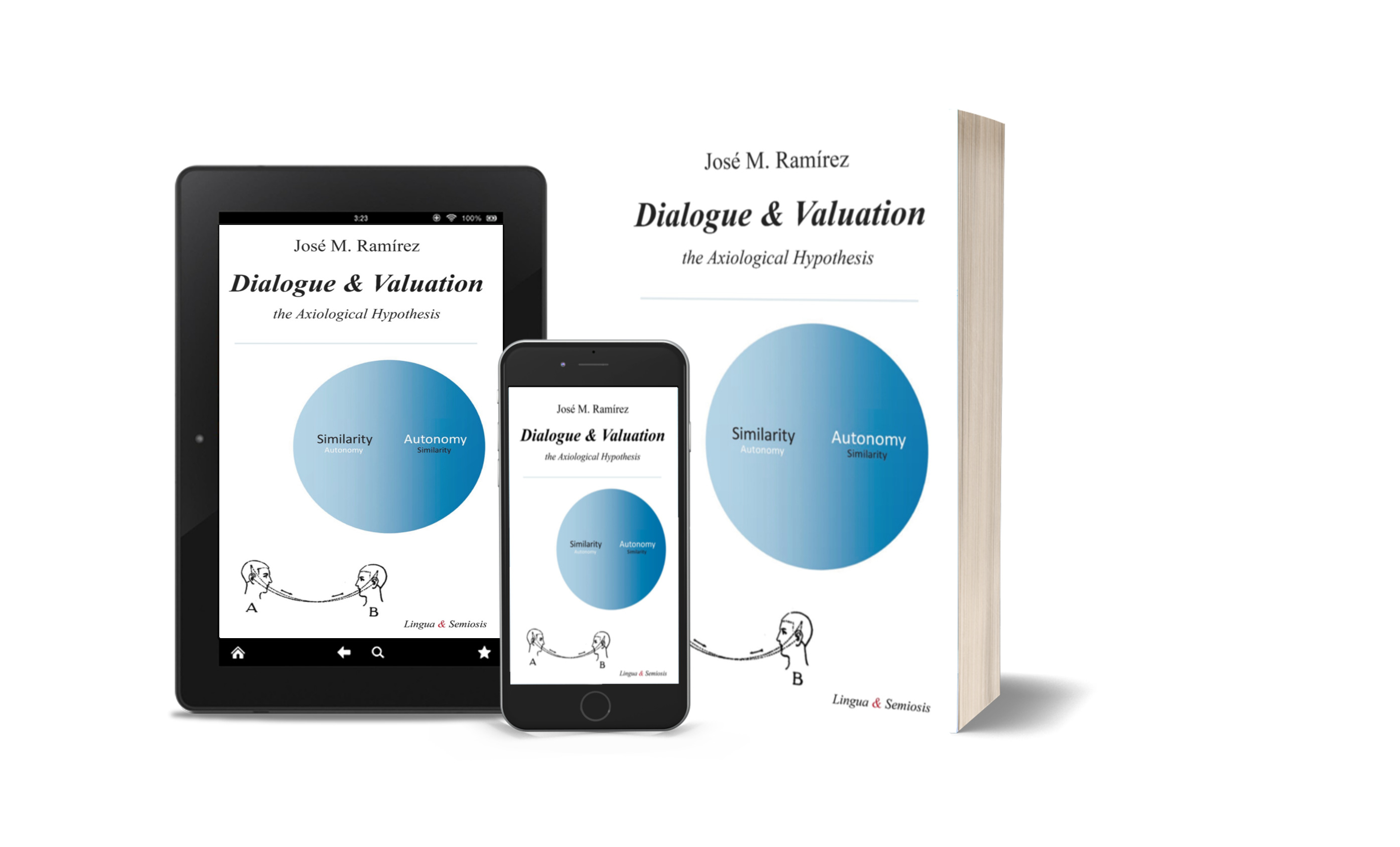
[the book, soon]
Interview with José M. Ramírez in Publish News, August 2025 (read)
[from book Introduction, preview]
What is and what is not the Theory of Dialogue and Valuation, or Humanistic Pragmatics
What is
The Theory of Dialogue and Valuation, or Humanistic Pragmatics, is a philosophy of language and a linguistic and semiotic theory. In its general aspects, it constitutes a simple and intuitive theory that can be learned and applied in just a few days.
It is eclectic and open to contributions from diverse schools of thought: phenomenology, pragmatics, and critical theory, as well as various currents in linguistics and semiotics.
It studies meaning and language within their cultural and psychological context—social, cognitive, environmental, and physiological.
In contrast to the traditional dichotomy, of Platonic origin, between the objectivity and subjectivity of values, it proposes the notion of interactional value.
It is based on the axiological or valuational hypothesis, which identifies and describes the dialogical sphere of value. In its non-formal version:
«Interlocutors are similar and autonomous.»
The axiological hypothesis was presented by José M. Ramírez in July 2023 in Lyon, France, at the 20th World Congress of AILA (International Association of Applied Linguistics).
It is a holistic theory supported by a scientific methodology. Its basis for analysis is provided by systemic functional linguistics, pioneered by M. Halliday, and the contextual models of T. van Dijk. It also incorporates elements from other schools of thought, such as the relevance mechanism and cognitive metaphors. Furthermore, it recovers the notion of linguistic value, from Ferdinand de Saussure, the founder of contemporary linguistics.
It allows for the analysis of both language production and comprehension.
It is a multifactorial and multidisciplinary theory that fosters complex thinking and bridges between the various disciplines of philosophy, science, technology, and art.
Its textual analysis relies on a non-aprioristic methodology, the Method Based on Constituents (MBC), which reconstructs complex values as semiotic functions.
It develops, as its counterpart, a value theory of ideologies.
It connects with the value principles of humanism, liberal democracy, and international law.
What is NOT
It is NOT an ethical or political doctrine. It entails an anthropology and a worldview, and promotes dialogue, critical thinking, and creativity.
It is NOT relativistic. Similarity and Autonomy are common principles.
It is NOT anthropocentric. Human beings are not the center of the cosmos, but rather the center of human knowledge and culture.
It is NOT an ideology. It is an open and flexible model that allows us to identify ideology as a process of group restriction on dialogue and valuation.
It is NOT a finished and closed theory, nor can it be: it is in constant evolution, in accordance with the character of genuine philosophy and science.
+ information on the Spanish Course on Humanistic Pragmatics
Factoría de la Lengua
 acvf_la vieja factoría